Showing posts with label marines. Show all posts

Tuesday, November 24, 2015

The Parting Glass, or The Joyous Life of a Thousand Goodbyes

Oh all the money that e'er I had / I spent it in good company
And all the harm that e'er I've done / Alas it was to none but me
And all I've done for want of wit / To memory now I can't recall
So fill to me the parting glass / Goodnight and joy be with you all

Oh all the comrades that e'er I've had / are sorry for my going away
And all the sweethearts that e'er I've had / would wish me one more day to stay
But since it falls unto my lot / That I should rise and you should not
I'll gently rise and I'll softly call / Goodnight and joy be with you all


Doctor and author Atul Gawande spoke last month at the Bryan Lecture Series about the effects of age, and the effect of proximity of death - really, the increased uncertainty regarding the risk of loss which age and some other conditions bring - on people’s perceived well-being and happiness. Dr. Gawande cites a study out of Stanford that shows fairly conclusively that the closer people are to the uncertainty of life - either to the end of their own life or to situations and circumstances that increase the possibility that life will soon end - the happier they are, the more they appreciate life. If you haven't yet read his book on this topic, "Being Mortal," then I commend it to you. 

I got to hang out this weekend with a fine bunch of Americans - men that don't need to read a book to appreciate the essence of Gawande's insights. Greater appreciation for life results from increased proximity to uncertainty regarding death? I think we call that sometimes wisdom.  It would be an unsurprising observation to many of These Men, no longer quite as young as they once were but still just as fine and full of spirit. 

Reflecting on the weekend, I want to tell them this, in ways that is hard to do over a beer or in a large ballroom: There is really no one else in this country that is as well equipped to live a joyous life as you guys are.  You have been there and you have seen the elephant, and you have come back. And whether it was through your own courage or plain dumb luck or directly due to the sacrifice of another - whether you deserve to be here or whether you do not deserve to be here -  it doesn’t matter.  You’re here.  You have an opportunity to live a joyous life.  You have learned, or had the opportunity to learn, how precious life is, how fleeting it can be, but also how glorious it can be in that uncertainty.  

The new Star Wars movie is coming out, a couple trailers released. I like many other males of a certain vintage have watched with pleasure these trailers and am excited to see the movie come out. I saw the third and final trailer just last week, right before heading to Las Vegas, and it’s a moving piece and it’s exciting.  It stirs the blood partly because you know what came before, you’ve seen all the movies, and to see a saga like that carried on is phenomenal.  But Jesus, there was one scene in that movie that spoke to me in a way that I’m not sure really spoke to many people.  Fleeting scene.  Here it is, cued up to the right spot (1:31):


Did you see - it's only a few seconds, 1:31 to 1:36. Have you ever shaken somebody’s hand in a moment like this?  Have you once been a warrior, walking off to the field of battle, and passed a fellow warrior headed out and stopped and said, "I need to shake this man’s hand one more time.  I need to look him in the eye and say I am proud to shake his hand and tell him to go off and do his job."  Yes, you have.  And the gaze between the two men, burning over the short distance, the clasp of hands pausing in a hectic moment. It was worth your time to stop and shake their hand, and that – whether the director intended that or not, whether he understood that or not, these actors nailed it. Fighter pilots scrambling to alert out on the tarmac; bombing crews huddling one last time before they go to their navigation seat, bombardier stations, ball turret guns; infantrymen leaving the wire on patrol.

You know that hand shake.  You’ve had a last hand shake with somebody. And it was worth it to say goodbye, so many other times when it turned out to be unnecessary.  Because once or twice, it was the last chance you had to shake That Man's hand. The Joyous Life of a Thousand Goodbyes.

It's hard to get together after 10+ years. It's hard to discover - almost surprisingly - that you are as at home with this group as you are with anyone else in the human race, because you know this weekend will be fleeting, and there will then be a void when it is over.  It's even harder still to part ways again, uncertain when in the next decade you will again have the chance to stand shoulder to shoulder with These Men. It was overwhelmingly therapeutic to see nearly 100 of our alumni answering this new call to arms: to reassemble and reminisce over scotch, cigars, and warm hazy memories of the finest days of our young lives, and the finest of us that did not return.

Best men I've ever known. Best job I ever had.

Goodnight, and joy be with you all 


Saturday, November 7, 2015

From the Halls of Montezuma...

The opening line of The Marine's Hymn no doubt has its roots, much like the resolution of the Oregon boundary dispute and the annexation of Texas, in the presidency of our Nation's Eleventh President.

James K. Polk, just one of three U.S. presidents born in North Carolina (yes, of course I am counting Andrew Jackson despite South Carolina's claim to the contrary - but yet Polk's birthplace is only a mile from the state line), was responsible for the U.S. invasion of Mexico in 1846, for which he sought and obtained a declaration of war from Congress. "From The Halls of Montezuma" refers to the Battle of Chapultepec, 12-13 September 1847, during which a force of Marines stormed Chapultepec Castle in a bloody but successful assault.

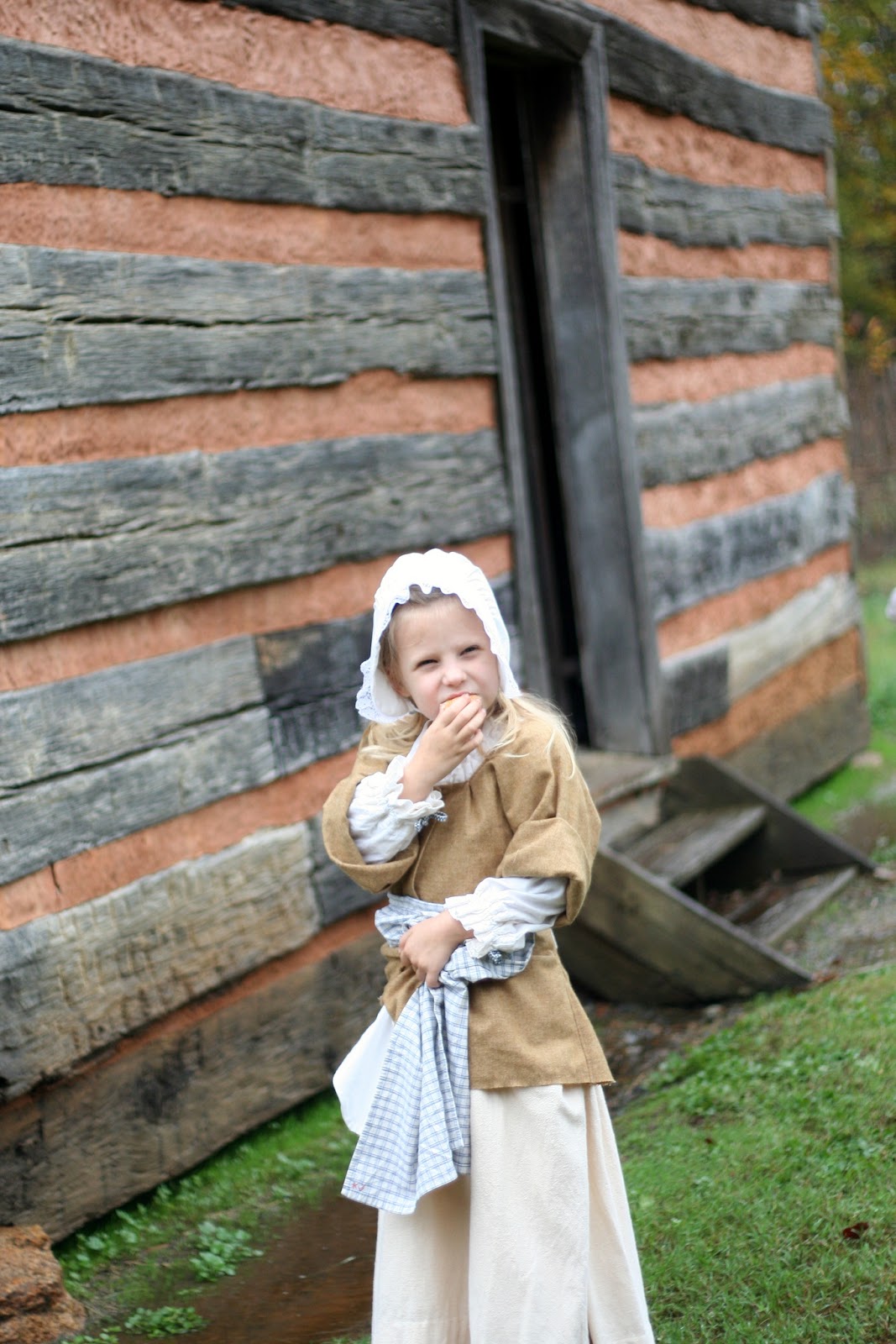
Today's history lesson was less about war-making and more about pie-making: we trooped on down to the confluence of Sugar Creek and Little Sugar Creek in southern Mecklenburg County, to the original birthplace of President Polk. There, in 1795, little James K. Polk (the first of ten children) was born in an inauspicious log cabin, a recreation of which adorns the site. We were guided in our journey of late 18th and early 19th century American frontier life by the High Docents of the Historical Cooking Guild of the Catawba Valley ("the premier hearth cooking organization of North Carolina"), who regaled us with pumpkin and apple pies, syllabub, "snowballs," doughnuts, wood smoke and history lessons.

From GG's armamenterium of period-specific items we obtained a solid 18th century outfit for both Caroline and Jack and a "good-enough" shift for Sam to wear. I am informed that children of that vintage would have been largely unshod at such an age, so we peeled off shoes and socks and out into the muddy drizzle they ran. It is remarkable how much fun kids can have if you will just let them be kids. Mud is really easy to wash off of bare feet, much more so than from shoes, and any remaining dirt hardly shows on the smooth-hewn wood floor of a log cabin.


The ladies of the cooking guild, who have been plying their craft of "authentic and historically accurate methods of 18th century hearth cooking and other historical foodways" for well over 25 years now, had clearly spent most of the morning preparing a feast for the visitors of the historic site. However, due to fortunate county food code restrictions, all of the food was solely for "display purposes" and none of the visitors were allowed to sample a taste. No such restriction applied to the "reenactors" themselves, our little critters included. So Jack spent most of the day crouched around the hearth or perched over the edge of the table, asking "can I try that?" or "can I have a bite of that?"


Above Left: Caroline, after swiping an apple; Above Right: the kids, sampling "the goods"


Full album of pictures is located here, courtesy as always of Google's Picasa Web Albums:


Thursday, November 10, 2011

Good Night, Chesty Puller!

Jack hummed along with me tonight during my adagio rendition of The Marine's Hymn at bedtime. Happy 236th, Mother Green!

Monday, May 2, 2011

My Thoughts on Bin Laden

I first heard about Bin Laden this morning on the way to work. Doc got out the driveway before me, then backed up with her window down a said “We killed Osama.” I smiled, gave a little fist pump and said “Awesome.” Then I got in the car and went to work.

I enjoyed catching NPR’s coverage on the way in to Elon, and quickly scanned the blogs and news feeds (Small Wars Journal, Opinio Juris, Abu Muquwama, CFR.org and the regular collection of bureaus) for what details were percolating up about this.. What struck me immediately in the comments to these articles, trending on Facebook and Twitter, and in discussion forums was the meathead, ugly American, “we got him and you can rot in hell, Islam” attitude that suddenly came to the forefront of so many people’s minds. I guess this underscores how sensitive an issue Osama Bin Laden represents. Apparently not so sensitive that many people (prior to today) gave it much thought in their day to day fretting over jobs, the economy, the price of gas, the 2012 election, Lindsey Lohan, etc. I guess the spontaneous celebrations are more of an emotional response by people looking for a bright spot in the news. I'll say I prefer a more considered, thoughtful, and insightful response of people that have worried and worked for years over these ideas and the role of America's power in the world. But of them all I liked Andrew Exum's post the best, about his gathering at the bar Sunday night for the press conference, because it hits close to home:
We went around, all of the veterans, each of us naming friends we had lost. I offered up Joel Cahill's name, and then that of Joe Fenty. I thought of the wives and young daughters those two men left behind, and I thought of so many more men and women who I never got the chance to know but who have given their lives since 2001.
I had told myself for years that the death of Osama bin Laden would not mean anything. Decapitation campaigns against sophisticated, mature terrorist networks, I knew, rarely yield strategic effects. But standing in that Washington bar, I was overcome with emotion.
If you consider the single-minded dedication with which the task force responsible for yesterday’s accomplishment has worked over the last decade, I think this reaction of the general public is a bit out of place. Certainly, those guys deserve a beer and a chance to celebrate. But I suspect, quiet professionals that they are, and given the investment they have in the mission in regards to training, lost friends, lost time at home, etc, that they will not be parading around waving the American flag and singing God Bless America on the steps of the White House. In fact, my first thought after “Awesome” was a quiet word of thanks to those guys and their families – not that there is no more work to do, but just the relief of a job - this job - well done. I bet among those gallant men there is some reflection, a strong sense of satisfaction, a remembrance of those lost along the way, and then a desire to kit up and get back out there.

As the details unfold of the mission, you’ll hear that they mocked-up a full scale compound for months of raid practice, (much like the Son Tay raid) and then had to pivot on the objective when an airframe had a mech failure. These are the best and brightest of America, as much or more as the denizens of any other tech, investment, industry or education sector of our county. You'll also hear about the intelligence yield from our program at Guantanamo and elsewhere, and the persistence and patience of our collection community in the targeting and planning of this operation. Try to remember about this stuff when you go back to your day to day lives and the worries that accompany them.

Now that everyone is paying attention to the War on Terror again, questions resurface about the character of our fight. What does this change? Certainly it is not the end, or even a big shift in the meaning of Al Qaida – AQ 2.0 has been in the game for several years and seems to have already executed their succession plan when Bin Laden was driven deep to hiding following Anaconda. Organized international terrorism is still a persistent and existential threat for the foreseeable future – instability across the globe still has the potential to breed unrest and sanctuaries in regions that we do not engage in a productive manner.  Will we continue to pay a billion (seriously) dollars a year to Pakistan? I bet not.

I do think that the one key achievement of the killing of Bin Laden is this - the US is now free to exit Afghanistan on the terms of our choosing, defining military and diplomatic goals, and even victory, free of the symbolic albatross that has hung ‘round our necks for so long. I haven't seen this mentioned much - perhaps it is just obvious. But this is really the #win in my mind – that the guys with 1/5 deployed to Sangin can go about their mission of engagement and COIN and stability operations – even “nation-building” – not as a placeholder for the greatest manhunt in our history, but because it is our enunciated national security policy. Or, if it is not, they can come home. But we can have that national conversation about what is an important exercise of our wealth, and power, and blood, independent of any iconic search for evil.

Hopefully this will also raise to the surface the continued work ethic and incredible sacrifice of our fellow citizens in uniform. If you have not heard of LtGen John Kelly, he has some particularly poignant remarks on the investment that these folks and their families have made in the future of our nation, at great peril to themselves and with increasingly little awareness of their real involvement. A friend reminded me just this weekend of one such example from my old haunt of Ramadi, where two young Marines from different worlds went face-to-face with the devil with fingers on the trigger. Cpl Yale and LCpl Haerter received the Navy Cross, posthumously, for their intrepidity, valor and dedication, but we don’t talk often enough about how important that spirit of service is to America. And we should, every day, consider that there are folks we call our neighbors that do not run from their post. Not for how long it takes to get the job done, if it takes 10 years or 6 seconds.

Semper Fidelis.


Wednesday, November 10, 2010

Semper Fidelis

November 10th, 1775. 235 years ago today our Beloved Corps was born in Tun Tavern, Philadelphia, when at the decree of the Continental Congress, Captain Samuel Nicholas, first commandant of the Marine Corps, offered guts and glory and a small tankard of ale to those few, proud strapping young men that came to be known as America's 911 Force: The United States Marines.

Not since the Spartans has a band of warriors had such a reputation for ferocity in battle and generosity at home. A breed apart, the Marines represent a fine distillation of what can be sustained by the fruit of democracy. The Marine Corps exists for two reasons alone: Making Marines, and Winning Battles.

I have always loved the imagery and cadence in the writing of John W. Thomason, a Marine Captain in World War I with the 1st Battalion, 5th Marine Regiment. His book, Fix Bayonets, if some of the finest American writing (and battlefield sketches) to come out of that war, and his essay, Leathernecks, excerpted below, is a great example.


***
LEATHERNECKS
by John W. Thomason 
THEY tell the tale of an American lady of notable good works, much esteemed by the French, who, at the end of June, 1918, visited one of the field hospitals behind Degoutte's Sixth French Army.  Degoutte was fighting on the face of the Marne salient, and the 2d American Division, then in action around the Bois de Belleau, northeast of Chateau Thierry, was under his orders.  It happened that occasional casualties of the Marine Brigade of the 2d American Division, wounded toward the flank where Degoutte's own horizon-blue infantry joined on, were picked up by French stretcher-bearers and evacuated to French hospitals.  And this lady, looking down a long, crowded ward, saw on a pillow a face unlike the fiercely whiskered Gallic heads there displayed in rows.  She went to it.

"Oh," she said, "surely you are an American!"

"No, ma'am," the casualty answered.  I'm a Marine."

The men who marched up the Paris-Metz road to meet the Boche in the spring of 1918, the 5th and 6th Regiments of United States Marines, were gathered from various places.  In the big war companies, 250 strong, you could find every sort of man, from every sort of calling.  There were North-westerners with straw-colored hair that looked white against their tanned skins, and delicately spoken chaps with the stamp of the Eastern universities on them.  There were large-boned fellows from Pacific-coast lumber camps, and tall, lean Southerners who swore amazingly in gentle drawling voices.  There were husky farmers from the corn-belt, and youngsters who had sprung, as it were, to arms from the necktie counter.  And there were also a number of diverse people who ran curiously to type, with drilled shoulders and a bone-deep sunburn, and a tolerant scorn of nearly everything on earth.  Their speech was flavored with navy words, and words culled from all the folk who live on the seas and the ports where our war-ships go.  In easy hours their talk ran from the Tartar Wall beyond Peking to the Southern Islands down under Manila; from Portsmouth Navy Yard-New Hampshire and very cold-to obscure bush-whackings in the West Indies, where Cacao chiefs whimsically sanguinary, barefoot generals, with names like Charlemagne and Christophe, waged war according to the precepts of the French Revolution and the Cult of the Snake.  They drank the eau de vie of Haute-Marne, and reminisced on sake, and vino, and Bacardi Rum-strange drinks in strange cantinas at the far ends of the earth; and they spoke fondly of Milwaukee beer.  Rifles were high and holy things to them, and they knew five-inch broadside guns.  They talked patronizingly of the war, and were concerned about rations.  They were the Leathernecks, the Old Timers; collected from ship's guards and shore stations all over the earth to form the 4 th Brigade of Marines, the two rifle regiments detached from the Department of the Navy by order of the President for service with the American Expeditionary Forces.  They were the old breed of American regular, regarding the service as home and war as an occupation; and they transmitted their temper and character and view-point to the high-hearted volunteer mass which filled the ranks of the Marine Brigade.

It is a pleasure to record that they found good company in the U. S. Army.  The 2d Division (U. S. Regular was the official designation) was composed of the 9th and 23d Infantry, two old regiments with names from all of our wars on their battle-flags, the 2d Regiment of Engineers-and engineers are always good-and the 12th, 15th, and 17th Field Artillery.  It was a division distinguished by the quality of dash and animated by an especial pride of service.  It carried to a high degree esprit de corps, which some Frenchman has defined as esteeming your own corps and looking down on all the other corps.  And although it paid heavily in casualties for the things it did-in five months about 100 per cent-the 2d Division never lost its professional character.

Seven years after, across the world from France, I met a major of the American General Staff, who was on the Paris-Metz road that last week in May, 1918, and saw the Marine Brigade.  "They looked fine, coming in there," he said.  "Tall fellows, healthy and fit-they looked hard and competent.  We watched you going in, through those little tired Frenchmen, and we all felt better.  We knew something was going to happen-" and we were silent, over Chilean wine, in a place on the South Pacific, thinking of those days and those men.

There is no sight in all the pageant of war like young, trained men going up to battle.  The columns look solid and businesslike.  Each battalion is an entity, 1,200 men of one purpose.  They go on like a river that flows very deep and strong.  Uniforms are drab these days, but there are points of light on the helmets and the bayonets, and light in the quick, steady eyes and the brown young faces, greatly daring.  There is no singing-veterans know, and they do not sing much-and there is no excitement at all; they are schooled crafts-men going up to impose their will, with the tools of their trade, on another lot of fellows; and there is nothing to make a fuss about.  Battles are not salubrious places, and every file knows that a great many more are going in than will come out again-but that goes along with the job.  And they have no illusions about the job.


There is nothing particularly glorious about sweaty fellows, laden with killing tools, going along to fight.  And yet-such a column represents a great deal more than 28,000 individuals mustered into a division.  All that is behind those men is in that column too:   the old battles, long forgotten, that secured our nation-Brandywine and Trenton and Yorktown, San Jacinto and Chapultepec, Gettysburg, Chickamauga, Antietam, El Caney; scores of skirmishes, far off, such as the Marines have nearly every year in which a man can be killed as dead as ever a chap in the Argonne; traditions of things endured and things accomplished, such as regiments hand down forever; and the faith of men and the love of women; and that abstract thing called patriotism, which I never heard combat soldiers mention-all this passes into the forward zone, to the point of contact, where war is girt with horrors.  Common men endure these horrors and overcome them, along with the insistent yearnings of the belly and the reasonable promptings of fear; and in this, I think, is glory.

In Charles the Second's time the English formed the first sea regiment-soldiers equipped as infantry, to serve on the sea in the fleet; to clear with musketry the enemy's decks and fighting-tops when the ship's of the line went into close action; to go ashore, and take up positions when the naval forces seized a base preliminary to land operations of the army.

Here by the way, comes the quip of old time:  "Tell it to the Marines."  They relate of Charles the Second that at Whitehall a certain sea-captain, newly returned from the Western Ocean, told the king of flying fish, a thing never heard in old England.  The king and the court were vastly amused.  But, the naval fellow persisting, the Merry Monarch beckoned to a lean, dry colonel of the sea regiment, with a seamed mahogany face, and said, in effect:  "Colonel, this tarry-breeks here makes sport with us stay-at-homes.  He tells us of a miraculous fish that forsakes its element and flies like a bird over the water."  "Sire," said the Colonel of Marines, "he tells a true thing.  I myself have often seen those fish in your Majesty's seas around Barbados-...."  "Well," decided Charles, "such evidence cannot be disputed.  And hereafter, when we hear a strange thing, we will tell it to the Marines, for the Marines go everywhere and see everything, and if they say is is so, we will believe it!"

The Continental Congress, on 10 November, 1775, authorized a corps of American Marines.  This was the first Federal armed force to be raised by the young nation, and it antedated both the Federal army and navy, which had until that time, been matters of individual commonwealths.  And since that date Marines have participated honorably in all American wars, and in some affairs, more or less interesting, where powder was burnt but which do not rate as wars.    


Captain Richard Dale's Marines served with John Paul Jones, and manned the fighting tops of his ship, the Bonhomme Richard.   The task of the Marines was to shoot down on the enemy ships, attending, in particular, to enemy officers.  When the crew of one ship boarded another, it was difficult or impossible to tell friend from foe from high above.  For that reason Marines officers adopted the peculiar device that resembled an embroidered cross so that their marksmen could tell friend from foe.  Look at any Marine officers barracks or dress hat.  You'll continue to see that same device embroidered there as a tribute to those long ago Marines who fought so gallantly some two-hundred years ago.  Marines love tradition. 

Those Marines in the fighting tops were also tasked, when possible, to drop explosive devices on the decks, or better yet through the hatches of enemy ships.  Such a device thrown from the fighting tops of the Richard set off the powder-magazine of H. M. S. Serapis. This event turned the tide of events in favor of the poor old Richard, in the fight off Flamborough Head.  There were United States Marines in Barney's naval force, formed across the Bladensburg Road, when Admiral Cockburn's people marched to burn Washington; and they stayed there until the line was turned by British regulars and they were all, including Barney, casualties;  it was the only material resistance the British met.  Marines marched to Mexico City in 1846; the red stripe on the blue trousers of officers and non-commissioned officers commemorates to this day service in that war.  Marines served in the Civil War very widely:  Marines died on Henry Hill at First Manassas  and on the fire-swept beaches in front of  Fort Fisher, and on the Mississippi around Vicksburg and Island No. 10.  Colonel Huntington's Marines took Guantanamo, landing from the U. S. S. Marblehead in 1898.  They marched to Peking in 1900, and were in the legation guard shut up there during the Boxer trouble.  Cuba knows them, and the Philippines.  They were ashore at Vera Cruz in 1914; every uneasy and volatile Wet Indian and Central American republic has become acquainted with them in a professional way, and their appearance at storm centers has always produced very presently a sweet tranquility.  The navy takes them there, and sends bluejackets and chow along always.  Every capital ship carries a guard of them.  Aboard ship, besides forming the nucleus of the ship's landing force, they man the secondary batteries, the five-inch guns; furnish guards of honor for the comings and goings of the admiral and distinguished visitors, and so forth; perform all manner of curious and annoying details; and post ship's sentries whose meticulous ideas about the enforcement of orders lacerate the souls of jolly mariners, seamen, and engineer ratings.  Normally, the strength of the corps is twenty per cent of the navy; just now there are about 19,000.  They constitute an organization within an organization, with their own commandant, who functions under the Secretary of the Navy, as a separate and distinct service like the U. S. Navy, as in the past, in time of war, the U. S. Coast Guard.  The rank and file are good enough Latinists to know what "Semper Fidelis"-which is their word-means; and any private will assure you the Marines are a corps d'elite.


In 1917, when trained Soldiers in the United States were at a premium, the Navy Department offered a Brigade of Marines for service in France; it was regarded desirable for Marine officers to have experience in large operations with the army; for it is certain that close co-operation between the army and the navy is a necessary thing in these days of far-flung battle lines.  The British distress at Gallipoli is a crying witness to this principle.  In a navy transport, therefore, U. S. S. Henderson, the 5th Regiment of Marines embarked for France in June, 1917,with the first armed American forces.  The 6th Marines followed.  The two regiments constituted the 4th Brigade, and served in the 2d Division.  U. S. Regular, until the division came home in August, 1919.  About 30,000 Marines were sent to France; some 14,000 of these were replacements to maintain the two regiments of the 4 th Brigade.  A brigade musters some 7,500 officers and men; this brigade took part in some very interesting events.

Elsewhere, I have written of the Marines in the war with Germany; how they went up, and what they did there, and how some of them came out again.  Being a Marine, I have tried to set forth simple tales without comment.  It is unnecessary to write what I think of my own people, nor would it be, perhaps, in the best taste.


And I have written of Marines in this war because they are the folks I know about myself.  Those battle-fields were very large, and a man seldom saw much or very far beyond his own unit, if he had a job in hand.  As a company officer, I always had a job.  There is no intent to overlook those very gallant gentlemen, our friends, the U. S. Army.  Their story is ours, too. 


***


Tuesday, November 9, 2010

This is what happens...

When Daddy makes poor little Caroline's bottles for school:


How am I going to explain this excessive esprit-de-corps to the ladies at daycare? I thought we had learned our lessons with the flippers episode..

Thursday, August 12, 2010

A tale of two (military history) books:

After reading the excellent war fiction Killing Rommel, I pulled the trigger on another North Africa campaign book, this one the recent military history text by rick Atkinson, Army at Dawn. The class of warriors that led us through the breach WWII are leaving us at the cyclic rate these days, to the detriment of our corporate knowledge and experience. I thought that North Africa would be a good topic, for it is where our Army as a world power was first bloodied - the dogfaces that stormed ashore at Omaha and Utah had first gotten their blood up at places like Kasserine and Sidi bou Zid. Sure, the Marines got bloody noses at every island in the Pacific from early '42 onward, but that had been happening to the Marines for years during the interwar period anyway.

An Army at Dawn skips the majority of the British Eighth Army's retreat to and subsequent drive out of El Alamein and begins with the Allied invasion landings at Morocco and Algiers. Atkinson ably chronologizes the personalities of the key characters of Operation Torch and devotes some time to the political and diplomatic interplay that form the underpinnings of any tactical maneuver of that size. Because of this, the focus on generals and interpersonal strife of the key players (which I grant is a key element of how things turn out in this sort of event), rather than the big blue arrows on the battlefield or the average Joe mucking it out, I had a hard time getting into this book. It is well researched and annotated, and provides a terrific bird-eye view of the strategic and operational levels. But it just wasn't a bell-ringer for me, although I'll try out the other two books in the trilogy just for res gestae's sake. To be quite honest, what really through me from the beginning was a writing style that was cumbersome and unreadable, with ridiculously long sentences and poorly chosen transition words. I recognize this might be law school speaking, but I just felt like I was slogging through each page.

On the other hand, although I have gotten just 30 pages into The Road to Guilford Courthouse, I can already tell it will be a favorite. Despite writing about the 18th century campaign of the British in the Colonial South, the pages fly by like the minutes in a battle and you quickly find yourself much more engaged than you anticipated. This single volume account of the American Revolution as it unfolded in the souther colonies of the Carolinas addresses an oft-overlooked aspect of that fight. Like John Keegan, Buchanan focuses on the sociological makeup of the armies involved and the civilizations that fielded them in searching for connections between similar results. It helps that the terrain is very familiar - from the battle of Fort Sullivan (later Fort Moultrie) and skirmishes at Breach Inlet, to landings at Seabrook and fighting at Cowpens and Greensboro, this is a story that unfolds in the backyard of my upbringing. I am looking forward to finishing this one.

Monday, August 9, 2010

Back to Work

Matilda reported this morning for a little bit 'o reserve duty, but not before taking a few pics of the little guy in my boots.


"Do I really have to go to work today?"

Tuesday, July 27, 2010

Wikileaks Commentary

I've been a longtime reader of Abu Muquwama (although I admit I've dropped off substantially since he went in-house at CNAS. Exum has a great commentary on the recent Wikileaks non-story:

"Here are the things I have learned thus far from the documents released via Wikileaks:
  • Elements within Pakistan's Directorate for Inter-Services Intelligence (ISI) support the Taliban.
  • The United States integrates direct action special operations into its counterinsurgency efforts in Afghanistan, targeting insurgent leaders through capture/kill missions.
  • Civilians have died in Afghanistan, often as the result of coalition combat operations.
I'm going to bed, but if I were to stay up late reading more, here is what I suspect I would discover:
  • 'Afghanistan' has four syllables.
  • LeBron is going to the Heat.
  • D'Angelo Barksdale didn't actually commit suicide in prison. Stringer Bell had him killed.
  • Although a document dated 17 October 2004 claims the Red Sox were down 3-0 in a seven-game series with the Yankees, they actually went on to win 4-3.
  • Liberace was gay.
  • The Pathan remains wily.
  • Julian Assange is a clown."
I think for the most part, the Wikileaks documents aren't much more sophisticated than what me and my trusty Corporals sent up the chain in Iraq in 04/05. Which is to say, or zero value at an operational level or higher (although I am sure there are some specific nuggets in there that are more important, like say the names of Afghans that have helped the US. Jeez, Assange, what were you thinking?)

More of Andrew Exum's op-ed in the NYTimes here.

Friday, July 23, 2010

Just the twelve - er... thirteen of us


You might be surprised to hear it, but there are actually twelve thirteen people in this picture. We had the pleasure of hanging out at the beach with several of our closest friends, knowing that Kim, Rae and Casey were fairly far along on the path to motherhood. Rae recently delivered a gorgeous little Callie, Casey's boy is due any day, and our Dash-2 is finally correctly oriented and on her final approach. Little did we know, Jessie was headed that way too!

From left to right: Adam, Jessie, GPII*, Stephen, Kim, Baby Girl Shaw, Jack, Casey, Baby Boy Middle-Quillen (or maybe Quillendorf, that sounds like a house that Harry Potter might have lived in...), Kris, Rachel, Callie!, and Matt. Quite a crew. I think that is thirteen, but you might want to check my math.

Not to mention, the Williams, the Pointers, the Shumakers are all cooking a little one right now. Man, is it baby-making time or what? I think we've got a whole rifle squad, almost. Or a peloton, if you are a Pomerantz. C'mon, Sara, it's time to get started on your Part Deux.

*GPII is the affectionately named soon-to-be-sibling of George, the Pomerantz's cat. No specific sex is implied by this name.

Sunday, June 20, 2010

My best accessory


Jackson likes to be involved.

Very involved.

Monday, June 14, 2010

To The Colors

"On June 14, Theodore Roosevelt was dining outside Philadelphia, when he noticed a man wiping his nose with what he thought was the American Flag. In outrage, Roosevelt picked up a small wooden rod and began to whip the man for 'defacing the symbol of America.' After about five or six strong whacks, he noticed that the man was not wiping his nose with a flag, but with a blue handkerchief with white stars. Upon realization of this, he apologized to the man, but hit him once more for making him 'riled up with national pride.'" See generally Wikipedia (internal citations ommitted); cf. 36 USC §110.

From the Flag Code:
  • When the flag is displayed from a staff projecting from a window, balcony, or a building, the union should be at the peak of the staff unless the flag is at half-staff. When it is displayed from the same flagpole with another flag, the flag of the United States must always be at the top except that the church pennant may be flown above the flag during church services for Navy personnel when conducted by a Naval chaplain on a ship at sea.
  • When the flag is displayed over a street, it should be hung vertically, with the union to the north or east. If the street runs north-south, the stars should face east. For streets running east-west, the stars should face north. If the flag is suspended over a sidewalk, the flag's union should be farthest from the building and the stars facing away from it.
  • When flown with flags of states, communities or societies on separate flag poles which are of the same height and in a straight line, the flag of the United States is always placed in the position of honor—to its own right. The other flags may be the same size but none may be larger.
  • No other flag should be placed above it. The flag of the United States is always the first flag raised and the last to be lowered.
  • When flown with the national banner of other countries, each flag must be displayed from a separate pole of the same height. Each flag should be the same size. They should be raised and lowered simultaneously. The flag of one nation may not be displayed above that of another nation in time of peace.
  • The flag should be raised briskly and lowered slowly and ceremoniously.
  • Ordinarily it should be displayed only between sunrise and sunset, although the Flag Code permits night time display "when a patriotic effect is desired." Similarly, the flag should be displayed only when the weather is fair, except when an all weather flag is displayed. (By presidential proclamation and law, the flag is displayed continuously at certain honored locations like the United States Marine Corps Memorial in Arlington and Lexington Green.)
  • It should be illuminated if displayed at night.
  • The flag of the United States of America is saluted as it is hoisted and lowered. The salute is held until the flag is unsnapped from the halyard or through the last note of music, whichever is the longest

Tuesday, June 1, 2010

Fix Bayonets!

On the evening of June 1st, 1918, Marines from the 5th Marine Regiment serving under the command of the U.S. Army Expeditionary Force conducted a forced march along the road to Chateau-Thierry, and plugged into the line against the Boche. One of my very favorite books is Fix Bayonets!, written by Captain John W. Thomason of First Battalion, 5th Marines. The cadence and imagery of his prose and his battlefield sketches do credit to the esprit-de-corps of the Marines in a way that few other authors have, before or since:

There is no sight in all the pageant of war like young, trained men going up to battle. The columns look solid and businesslike. Each battalion is an entity, 1,200 men of one purpose. They go on like a river that flows very deep and strong. Uniforms are drab these days, but there are points of light on the helmets and the bayonets, and light in the quick, steady eyes and the brown young faces, greatly daring. There is no singing—veterans know, and they do not sing much—and there is no excitement at all; they are schooled craftsmen, going up to impose their will, with the tools of their trade, on another lot of fellows; and there is nothing to make a fuss about. Battles are not salubrious places, and every file knows that a great many more are going in than will come out again—but that is along with the job. And they have no illusions about the job.

There is nothing particularly glorious about sweaty fellows, laden with killing tools, going along to fight. And yet—such a column represents a great deal more than 28,000 individuals mustered into a division. All that is behind those men is in that column, too: the old battles, long forgotten, that secured our nation—Brandywine and Trenton and Yorktown, San Jacinto and Chapultepec, Gettysburg, Chickamauga, Antietam, El Caney; scores of skirmishes, far off, such as the Marines have nearly every year—in which a man can be killed as dead as ever a chap was in the Argonne; traditions of things endured and things accomplished, such as regiments hand down forever; and the faith of men and the love of women; and that abstract thing called patriotism, which I never heard combat soldiers mention—all this passes into the forward zone, to the point of contact, where war is girt with horrors. And common men endure these horrors and overcome them, along with the insistent yearnings of the belly and the reasonable promptings of fear; and in this, I think, is glory.
THEY LOOKED FINE, COMING IN THERE . . . THROUGH THOSE LITTLE TIRED FRENCHMEN.


Semper Fidelis, Marines.


Bonus Update: On tonight's edition of Jeopardy!, the $1200 question in the category "Woodrow Wilson's War" featured the 5th and 6th Marine Regiments at Belleau Wood.


Monday, May 31, 2010

In Memoriam

Remember our War Dead:

Shane Goldman (Zaidan, 4/5/04)
Chris Ramos (Zaidan, 4/5/04)
Matthew Serio (Zaidan, 4/5/04)
Jesse Thiry (Zaidan, 4/5/04)
Bill Harrell  (Fallujah, 4/8/04)
Josh Palmer  (Fallujah, 4/8/04)
Michael Wafford (Fallujah, 4/8/04)
George Torres (Fallujah, 4/11/04)
Noah Boye (Fallujah, 4/13/04)
Kevin Kolm (Fallujah, 4/13/04)
Michael Carey (Karmah, 5/18/04)
Garry Rimes (Ramadi, 4/1/05)
Jamie Edge (Ramadi, 4/14/05)
Kelly Cannan (Ramadi, 4/20/05)
Mary Mortensen (Ramadi, 4/20/05)
Jeff Starr (Ramadi, 5/30/05)
Cesar Baez (Ramadi, 6/15/05)
Jonathan Flores (Ramadi, 6/15/05)
Jesse Jaime (Ramadi, 6/15/05)
Chad Maynard (Ramadi, 6/15/05)
Tyler Trovillion (Ramadi, 6/15/05)
Dion Whitley (Ramadi, 6/15/05)
Erik Heldt (Ramadi, 6/16/05)
John Maloney (Ramadi, 6/16/05)
Adam Strain (Ramadi, 8/3/05)
Ramon Gonzales (Ramadi, 8/8/05)
Evenor Herrera (Ramadi, 8/10/05)

I caught a clip on NPR this afternoon, featuring LtCol Andrew Bacevich USA(Ret.) about his take on Memorial Day. Also a professor of international relations and frequent author on America's modern wars, Bacevich's perspective on the role of Memorial Day was changed forever when his son, an Army lieutenant, was killed in Samarra, Iraq in 2007.

-----------------------------------------------------


Young Fellow My Lad

"Where are you going, Young Fellow My Lad,
On this glittering morn of May?"
"I'm going to join the Colours, Dad;
They're looking for men, they say."
"But you're only a boy, Young Fellow My Lad;
You aren't obliged to go."
"I'm seventeen and a quarter, Dad,
And ever so strong, you know."

* * * *

"So you're off to France, Young Fellow My Lad,
And you're looking so fit and bright."
"I'm terribly sorry to leave you, Dad,
But I feel that I'm doing right."
"God bless you and keep you, Young Fellow My Lad,
You're all of my life, you know."
"Don't worry. I'll soon be back, dear Dad,
And I'm awfully proud to go."

* * * *

"Why don't you write, Young Fellow My Lad?
I watch for the post each day;
And I miss you so, and I'm awfully sad,
And it's months since you went away.
And I've had the fire in the parlour lit,
And I'm keeping it burning bright
Till my boy comes home; and here I sit
Into the quiet night.

* * * *

"What is the matter, Young Fellow My Lad?
No letter again to-day.
Why did the postman look so sad,
And sigh as he turned away?
I hear them tell that we've gained new ground,
But a terrible price we've paid:
God grant, my boy, that you're safe and sound;
But oh I'm afraid, afraid."

* * * *

"They've told me the truth, Young Fellow My Lad:
You'll never come back again:
(Oh God! the dreams and the dreams I've had,
and the hopes I've nursed in vain!)
For you passed in the night, Young Fellow My Lad,
And you proved in the cruel test
Of the screaming shell and the battle hell
That my boy was one of the best.
"So you'll live, you'll live, Young Fellow My Lad,
In the gleam of the evening star,
In the wood-note wild and the laugh of the child,
In all sweet things that are.
And you'll never die, my wonderful boy,
While life is noble and true;
For all our beauty and hope and joy
We will owe to our lads like you."

Robert William Service

Tuesday, May 18, 2010

Maggie's Drawers


It wasn't a total miss, at least, but my attempt at completing a rifle qual down at Camp Lejeune this past weekend was not as successful as I hoped. I tagged along with 4th MLG's HQSVCBN Comm Co. and hoped to be able to shoot the M16 on the KD range, as well as qualify on the pistol. However, due to some unexplained cluster the company only brought enough rifles for about 90% of the Marines, and I ended up in the unfortunate 10%. I did get to shoot the pistol, and qualified as sharpshooter on my first try without a warm-up round. A bit off the pace of my previous 3 expert qualifications, but I hadn't handled a Beretta in over 4 years and the double action speed round gave me some issues.

The known distance range was fun, despite being a mere spectator. I appreciate the fact that Marines still must qualify annually from 500yds, despite the fact that combat optics have largely replaces iron sights due to operational requirements.

In writing this post, I stumbled across these sketches by Kris Battles, currently serving as a combat artist with the Marines. They remind me of the many sketches that color the pages of John Thomason's classic Fix Bayonets!

You may still be wondering about the title of the post. Imagine briefly that you are laying in the hot dust and grass of the range, peering through the rear aperture sight, thinking about your breathing and trigger control, sight alignment and sight picture, and BANG. The shot is off and the target goes down. As it comes back up for your score a few moments later, a bright red flag waves left to right across the target face as the report "No Impact No Idea" rings in your ears. That flag? Those are the bright red underpants of Maggie, the range mistress. Congratulations, you've just met Maggie's Drawers.


Tuesday, May 11, 2010

Textbook Russian Ingenuity

Russian warship Marshal Shaposhnikov (file picture 2003)You really have to appreciate the Russians' pragmatic approach to problem solving. For years, a patchwork of dated law, jurisdictional conflicts and human rights concerns has plagued modern suppression of piracy (and terrorism). Too often, military forces cannot or do not detain pirates because of the unlikelihood of a successful domestic criminal prosecution, the chance that unscrupulous fellows may seek asylum in the host nation, or the risk that turning them over to their own county will result in human rights violations (read: execution) for which the detaining county is potentially liable. Leave it to the Russian Navy to handily dismiss all of those concerns.


BBC News - Freed Somali pirates 'probably died' - Russian source:

Ten suspected Somali pirates captured by the Russian navy last week may have perished after their release, a defence source in Moscow has told reporters. Marines seized them during a dramatic operation to free a hijacked Russian oil tanker far from shore, killing an 11th suspect in the gun battle. They were released in an inflatable boat without navigational equipment.

Within an hour, contact was lost with the boat's radio beacon, the defence source said.
'It seems that they all died,' the unnamed source was quoted as saying by Russia's Interfax news agency."

Apparently the Russian plan can be summed up as something like this:

  1. Day 1: "We have captured some insidious pyrates and will try them in a Moscow court of law"
  2. Day 2: "The law in this area is confusing - we will release the pyrates."
  3. Day 3: "Unfortunately, it appears the released pyrates have died." (after being released in a small craft in the middle of the IO, hundreds of miles from shore, without communication or navigation equipement)
  4. Day 4: "What is the big deal? They are pyrates!"

Good job, Russkies.

Wednesday, May 5, 2010

Badass Extract

Sweet shot:

U.S. Special Forces are extracted from a mountain pinnacle in Zabul province,
Afghanistan,by a U.S. Army UH-60 Black Hawk helicopter from Company A,
2nd Bn, 82nd Aviation Reg't,82nd Combat Aviation Brigade after executing an
air assault mission to disrupt insurgent communication.


Friday, April 9, 2010

Gotta love the Aussies...


Matilda owes much of its lineage to the fighting prowess of the ANZAC warriors. So we were not surprised to see a preview of some of the latest sniper-training technology show up at this western Australia SOF training facility.

The Rover system by Marathon applies state-of-the-art robotic technology to live-fire sniper training. This approach simultaneously improves realism and challenge of training while reducing the overall cost of ownership.

With the Rover system, a single instructor can conduct complex long-duration scenarios with multiple free-ranging targets. No need to use a joystick – just give the command and off they go, following a pre-orchestrated scenario. When a target is shot, it provides instant visual feedback by stopping and dropping its mannequin. It simultaneously sends a message to other targets, who can react by running for cover.


Fast-forward to 4:45 for some real "action". My favorite part? When one robot is shot, the others "run for cover." Awesomeness.

Apparently, the Segway is more useful than just giving cops another way to do their job without having to actually walk..